
Appomattox Projected and Actual Release Dates
A projected date is calculated before the custody event. It reflects the sentence information, applicable credit rules, and the facts available at that point. An actual date is documented after the holding agency processes the release, discharge, or transfer. VADOC procedures allow staff to disclose projected parole-eligibility, mandatory-parole, and good-time release dates as of the inquiry. The words “as of” matter because the answer can change.
For a state prisoner, the final Order of Release, release status, conditions, and gate pass are stronger proof than an earlier estimate. For a local or regional jail sentence, BRRJA's final computation and booking/release entry are the better sources. A court order explains the legal sentence and any later change, but the docket does not necessarily show the exact time the facility completed release processing.
Find an Appomattox Projected Release Date
Begin with the authority that computes the active term. VADOC says either local or state authorities calculate time depending on the sentence type and active term. The Appomattox County Sheriff's public page does not provide a projected-date tool. ACADC's locator is a current-custody check, not a published sentence calculator. The VADOC Inmate and Supervisee Locator is appropriate when a person is under VADOC custody or supervision.
- Identify the current custodian and sentence type. Do not use a state-prison search for a person serving only a local BRRJA term.
- For VADOC, search the Inmate and Supervisee Locator by seven-digit DOC ID when possible. A name search needs the first three letters of the first name and the full last name.
- Open the correct result and copy the exact date label shown. Do not rename an anticipated date as an actual release date.
- For a local sentence, ask BRRJA for its current computation and written earned-credit policy. Compare the answer with the court's sentencing order and jail-credit award.
- For a pretrial case, check bond and court action instead of seeking sentence credits. Confirm physical processing with the holding facility.
- After the date arrives, obtain the final release, discharge, or transfer entry from the agency that held the person.
A broader named-person search can be traced through the Appomattox County released inmates home page. That path helps identify the last custodian before a date request is sent.
Appomattox VADOC Release Date Fields
The official VADOC locator combines institutional custody with community supervision. It may cover people in VADOC institutions, probationers and parolees supervised by district offices, people in institutional hospitals, some local or regional jail prisoners under VADOC authority, and CCAP participants. A community district result can show that prison confinement ended while state authority continues. It is not the native record for a person who served only a local jail sentence.
| Locator item | How to use it | Limit |
|---|---|---|
| Seven-digit DOC ID | Best search key for one state record | Does not identify a BRRJA-only booking |
| Name | Use required first-name letters and full last name | Similar names require added checks |
| Location or status | Separates an institution from a supervision district | Does not give a county-jail exit time |
| Projected date label | Record the live label and value exactly | Provisional and subject to later change |
| Daily update warning | Shows why same-day facts need direct confirmation | Public data may be inaccurate or dated |
The official VADOC locator shows the search route used for Appomattox state-custody cases.
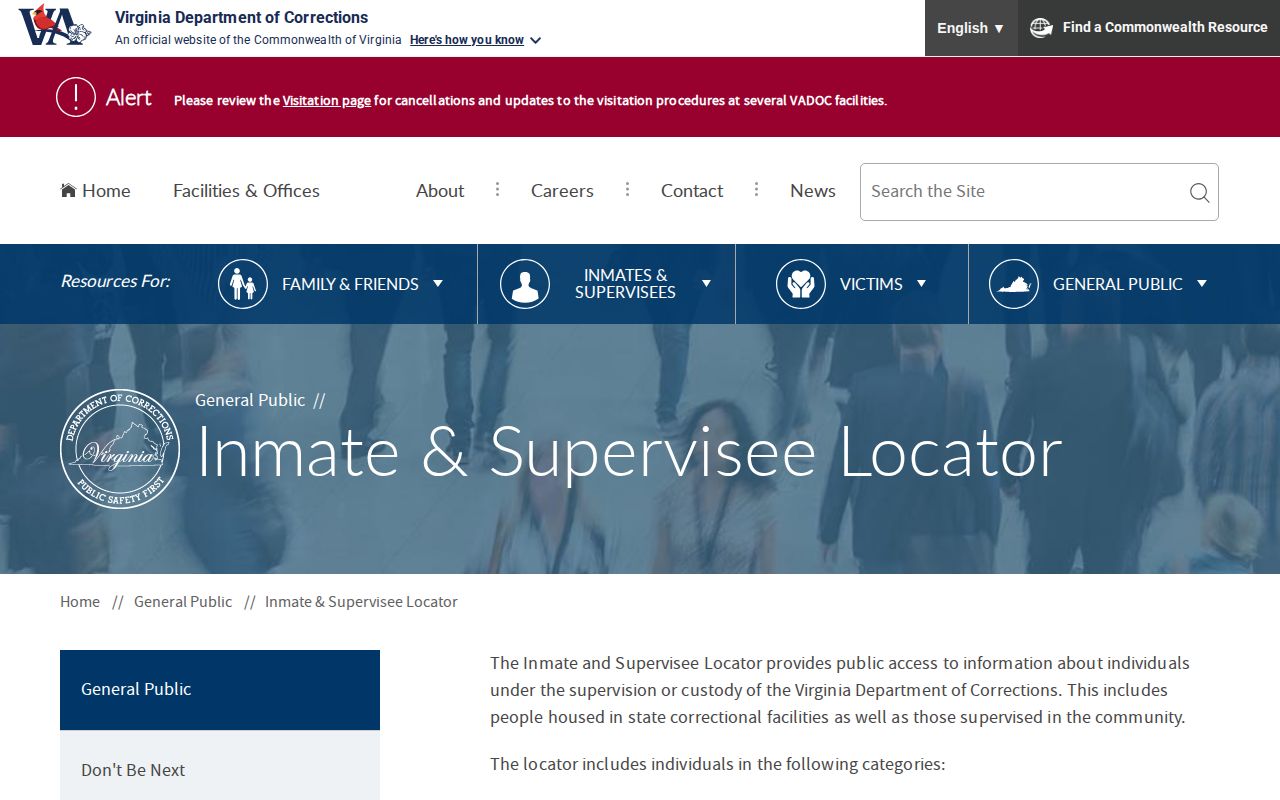
The captured search and detail views illustrate why the exact status, location, and date label must be preserved together.
Note: A person fully discharged from VADOC authority may no longer fall within the locator's stated custody-and-supervision scope.
Appomattox Pretrial Release Has No Projection
A pretrial detainee has not begun a sentence-credit release calculation. The next custody event may depend on bond, a hearing, dismissal, a plea, a trial, or another hold. Even if a court grants bond or dismisses one charge, another case or detainer may keep the person confined. The facility must process the legal authority before physical release occurs.
Appomattox General District Court handles misdemeanors, traffic matters, and felony preliminary proceedings. Circuit Court handles felony trials and appeals. If a felony is certified from General District Court, follow it into Circuit Court rather than treating the first docket as the final result. The Virginia Find a Case route can locate adult case information, while the clerk provides the official order.
Use the order to understand the legal basis, then use the Sheriff or BRRJA record to confirm processing. “Disposed” is not a release code. It can accompany an active jail term, a suspended term, probation, or credit for time served. Juvenile case information is not generally available online, and a missing public case should not be converted into a release claim.
Virginia Credits Shape Appomattox Release Dates
For felony offenses committed on or after January 1, 1995, Virginia's Earned Sentence Credit framework generally replaces the older parole and good-conduct system, subject to statutory exceptions. Virginia Code § 53.1-202.2 defines eligibility and treats one credit as one day deducted. The offense, conviction date, statutory exclusion, earning level, conduct, and program criteria all affect the computation.
Under § 53.1-202.3, enumerated offenses are capped at zero to 4.5 credit days for each 30 days served. At the maximum rate, 30 days served plus 4.5 credits satisfy 34.5 sentence days, about 86.96 percent of that computed span. It is inaccurate to turn that example into a universal claim that each Virginia prisoner serves exactly 85 percent.
Eligible offenses under subsection B use four earning classifications. Level I permits up to 15 days per 30 served, Level II permits 7.5, Level III permits 3.5, and Level IV permits none. § 53.1-202.4 supports criteria and forfeiture rules. A date lookup must therefore be tied to the actual offense and current classification, not a broad percentage quoted without the record.
Note: Earned credits alter a computation; they do not prove that the facility completed an actual release.
Older Appomattox Good-Time Release Rules
Older Good Conduct Allowance rules can apply to pre-1995 felony cases and older misdemeanor regimes. Virginia Code § 53.1-199 and § 53.1-201 include classifications of 30, 20, 10, or zero days for each 30 days served in the relevant framework. Those rules should not be blended with the newer earned-credit levels.
Pretrial confinement credit is another separate input. Under § 53.1-187, qualifying actual confinement while awaiting trial or appeal can be credited. Time on bail is not confinement. The court order, commitment papers, and sentence computation should agree on the credited days. If a credit appears to be missing, ask the court and computing authority to identify the controlling record instead of recalculating the date from a docket summary.
- Active term
- The portion of the sentence that calls for actual confinement.
- Earned sentence credit
- A statutory day deducted from the term under the applicable modern framework.
- Good Conduct Allowance
- An older credit regime that applies to qualifying sentences.
- Pretrial credit
- Qualifying time spent in actual confinement before the sentence was imposed or finalized.
- Mandatory minimum
- A term that limits the ordinary operation of credits when the controlling law requires service.
BRRJA Appomattox Release Date Computation
Local and regional jail sentences follow their own record path. Virginia Code § 53.1-116 requires individual prisoner records and a written local earned-credit and revocation policy. Unless a mandatory minimum controls, a prisoner sentenced to 12 months or less for a misdemeanor can earn one good-conduct day for each day served without a rule violation. Other provisions address parole-eligible prisoners and possible institutional work or class credits.
Ask BRRJA for the current written policy and the final computation tied to the person's booking and case. Do not assume ACADC uses a VADOC date merely because the person has an Appomattox case. Some people in local or regional jails are under VADOC authority, but that status must be shown in the record. The court's active term, credited confinement, and any mandatory minimum must be reconciled with the jail's calculation.
The Appomattox Sheriff and BRRJA are separate record holders. A short Sheriff lockup followed by transport to ACADC is not the same as release to the community. The Sheriff's transfer entry identifies the end of its custody, while BRRJA's eventual release or transfer record describes the next event.
What Changes Appomattox Release Dates
A projected date should be saved with the retrieval date and source. That makes later changes easier to explain. Some changes alter the numerical sentence computation. Others leave the date intact but change where the person goes. A detainer, for example, can cause one agency to release the person directly to another custodian. That is not community release.
| Factor | Effect on the date or event | Best confirmation |
|---|---|---|
| Corrected court order | Changes the active term or legal basis | Entered order and revised computation |
| Added jail credit | Reduces the remaining computed term | Court credit record and agency calculation |
| Consecutive or concurrent terms | Changes how sentence periods relate | Sentencing orders and time computation |
| Earning level change | Changes how fast eligible credit accrues | Current VADOC computation |
| Credit forfeiture or restoration | Moves the projected date later or earlier | Agency credit record |
| Detainer or hold | May change the destination rather than end custody | Release or transfer entry naming the receiver |
| Parole action | Can authorize a different release path for an eligible case | Board action plus final VADOC release order |
Weather can affect processing as well. VADOC's official facility-release page says a person completing a state facility sentence is released by 11:59 p.m. on the release date, weather permitting. That statement sets an outside operational frame for a state facility. It is not an ACADC release-hours rule, and no fixed local release time was found.
Note: A change in destination can end one agency's custody while confinement continues under another authority.
Confirm Appomattox Actual Release Dates
When the projected day arrives, check the current custodian rather than relying on yesterday's screen. A VADOC institutional result may move to a community-supervision district after release. An ACADC result may disappear because of release, another BRRJA placement, or a VADOC transfer. The blank roster alone cannot distinguish those outcomes.
For VADOC, request the final Order of Release or discharge document, actual date, release type, and custody status. For ACADC or another BRRJA site, request the booking/release sheet, release time and disposition, and any transfer destination. For Sheriff-created lockup or transport events, use the Appomattox County Sheriff FOIA route. A court order can explain why release was authorized, but the holding agency confirms the physical event.
Virginia Jail VINE can send local and regional custody-event alerts. A transfer to VADOC crosses to the separate NAAVI state-custody notification path, so registration does not automatically follow. The Appomattox VINE Inmate Check explains that notification split. Preserve an alert as a timely lead, then verify its event wording with the record custodian.